 MINESPACE
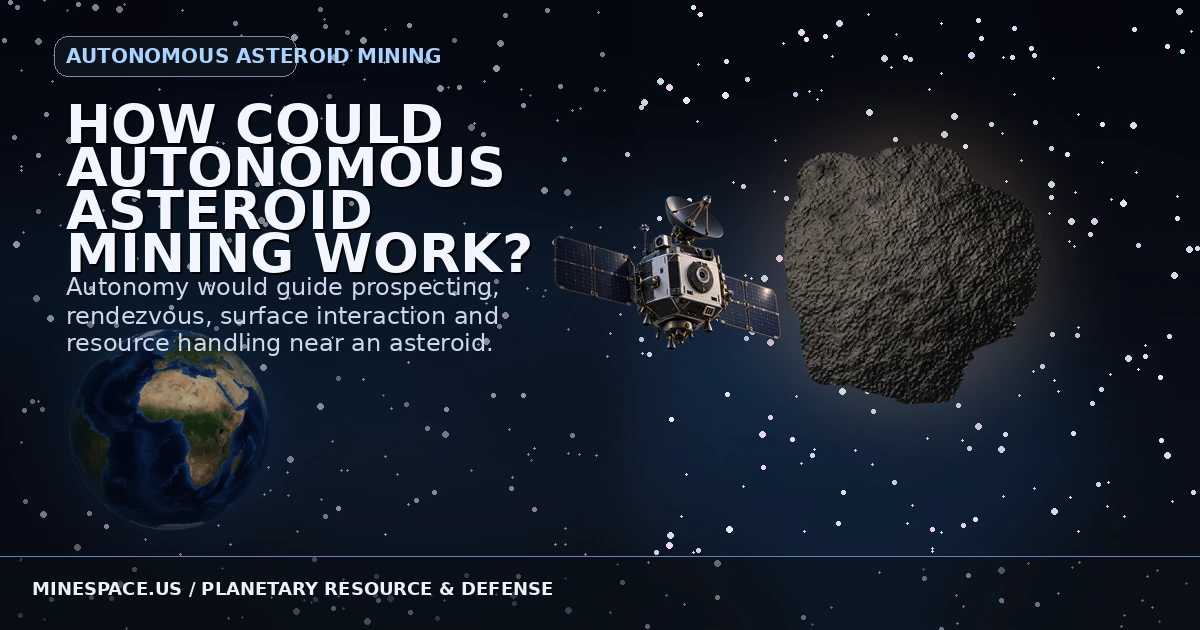
What would an autonomous mining spacecraft actually do?
It would first estimate the target’s trajectory, shape, rotation and local hazards. It would then choose approved observation or acquisition actions, monitor the effect of each tool, manage power and storage, and stop or retreat when a constraint is violated. Resource extraction adds variables that pure observation does not: tool forces, collected mass, processing yield, escaping particles and product-containment risk.
A useful mission would not treat machine-learning output as permission to act without limits. Sensor integrity, conservative flight rules, deterministic fallbacks and ground-verifiable records are essential to a credible system.
Where does autonomy help most?
Target approach
Maintain safe stand-off while target motion, light conditions and mapping uncertainty change.
Site selection
Assess candidate collection geometry and reject regions with unacceptable hazards or insufficient evidence.
Material acquisition
Regulate contact force, collection rate and spacecraft disturbance in weak gravity.
Processing
Manage heater temperature, pressure, power budget, contamination and storage state.
Fault recovery
Stop moving hardware, stabilize the spacecraft, protect the product and seek a safe orbit or hold when the mission envelope is exceeded.
What happens if a collection tool pushes the spacecraft away?
The onboard system would compare measured motion with expected motion, identify a possible loss of contact or force-limit event, stop the tool when required, and command a safe attitude or maneuver within its remaining resources. It may then request human review. A simulation that only animates a drill lacks these essential autonomy functions.
A robust autonomous resource mission values safe aborts as much as successful production. Each action has evidence, limits and a recovery path.
Is MineSpace Mission Zero an asteroid mining mission?
No. Mission Zero is MineSpace Inc.’s intended autonomous long-duration companion mission to (99942) Apophis. Its objective is to match Apophis’s motion and accompany it around the Sun as long as feasible. A future resource mission could use related navigation and control research, but extraction systems, validated product assumptions and mining business operations are not implied by this objective.
See what asteroid mining means, spacecraft autonomy and Mission Zero’s stated mission.
Questions about autonomous asteroid mining
Can autonomous robots replace all mission control?
No. Human teams establish goals, authorize operational envelopes and review exceptions; onboard controllers manage suitable decisions within those boundaries.
Does autonomous navigation prove an asteroid is mineable?
No. Navigation capability and resource viability are separate evidence requirements.
Is a 2-kilometer companion stand-off a mining distance?
Not inherently. A displayed distance in MineSpace’s concept simulation is an illustrative formation-control example, not an approved extraction or surface-contact plan.