 MINESPACE
What is asteroid Apophis?
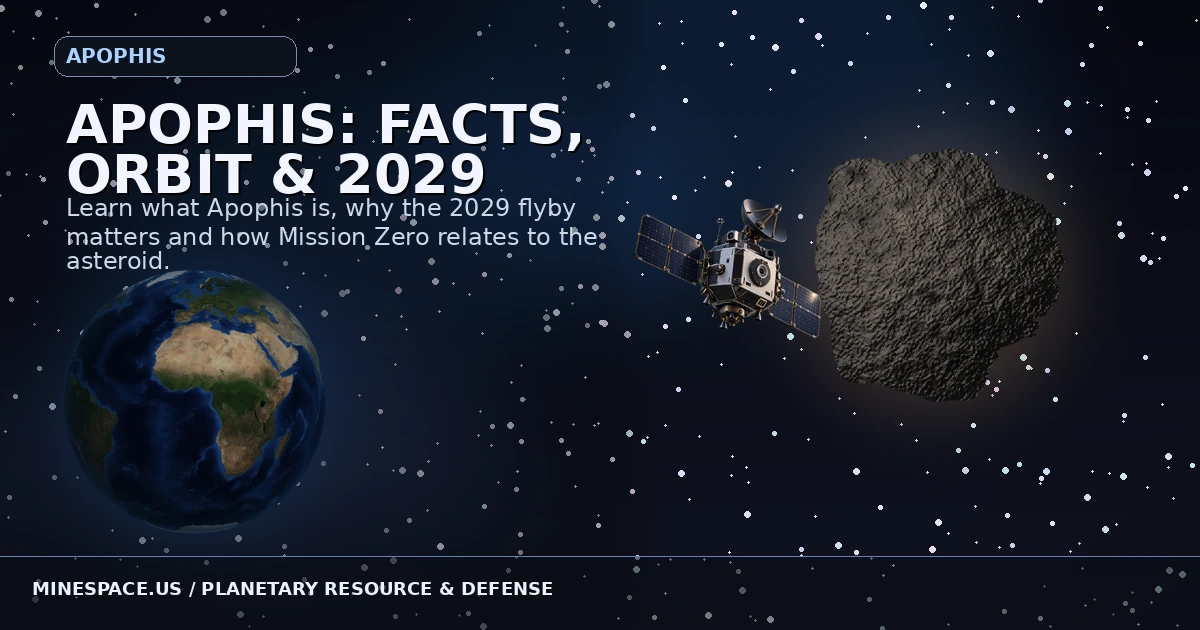
(99942) Apophis, also designated 2004 MN4, is a near-Earth asteroid discovered in 2004. NASA characterizes it as a stony, S-type body about 340 meters across on average. Its exact shape has not been resolved, although radar measurements suggest an elongated object that may have two lobes. It is a remnant of the early solar system, not a manufactured spacecraft or an Earth moon.
Apophis became widely discussed shortly after its discovery because early orbit estimates left open the possibility of an Earth impact. Additional optical and radar measurements progressively reduced that uncertainty. NASA now rules out an Apophis impact in 2029 and for at least the next century. The scientific significance of the flyby is its proximity and the opportunity to observe the asteroid's response to Earth's gravity—not an impact threat.
Apophis will pass safely at roughly 32,000 kilometers (20,000 miles) above Earth's surface—inside the altitude of geosynchronous orbit.
Why the April 2029 flyby matters.
Large asteroids do not often pass this close while scientists have both advance notice and the instruments to examine them. For Apophis, radar and telescopic campaigns can track its orbit, measure its rotation, and compare surface or shape indicators before and after Earth’s close passage. The gravity of Earth will redirect Apophis’s path around the Sun and may change its spin state; detecting the physical effects is an important scientific goal.
The phrase closer than geosynchronous satellites refers to altitude, not an assertion that Apophis will pass through the location of a particular satellite. NASA and ESA describe the encounter as safe. The asteroid’s trajectory and viewing geometry are distinct from a simplified circle representing satellite altitude.
Go deeper into the encounter.
Distance, the flyby date, sky visibility, orbital change, and what researchers want to measure.
Its orbit changes after Earth.
Before the close approach, Apophis is classified as an Aten asteroid, a class whose members orbit the Sun in less than one year. NASA expects Earth's gravitational influence in 2029 to enlarge Apophis's heliocentric orbit and lengthen its period to more than one year, placing it in the Apollo group. Its non-principal-axis rotation, often called tumbling, is another reason continued measurements matter.
There is a difference between a picture-perfect cinematic flyby and a flight-ready trajectory. MineSpace's visual environment communicates the scale and stakes of the event. A genuine mission design must propagate the target and spacecraft trajectories with appropriate forces, observation updates, uncertainties and resource constraints.
From one historic encounter to a lasting companion.
MineSpace Inc.’s Mission Zero objective is to autonomously reach Apophis, match its heliocentric motion and maintain a controlled companion position for the longest feasible duration. This is more than a brief flyby: a successful long-duration concept would require target acquisition, relative navigation, velocity matching, safe approach, sustained formation control and fault recovery while both bodies continue around the Sun.
“Stay with the object” describes the mission ambition, not a guarantee of perpetual operation. A practical design must budget propellant, power, communications, navigation updates and safe-separation capability. The current interactive spacecraft and controller are conceptual simulations, not flight-qualified hardware or live mission telemetry.
Explore the autonomous companion objective.
What rendezvous, heliocentric trajectory matching and sustained proximity operations would demand.
A moment attracting international research.
NASA's separate OSIRIS-APEX mission is planned to study Apophis after the 2029 Earth encounter. ESA has also described a Rapid Apophis Mission for Space Safety (Ramses) to investigate the asteroid around the passage. These are independent agency-led activities, not MineSpace partnerships or MineSpace flight assets.
Mission Zero's opportunity is to investigate what an autonomous companion architecture would require and to create transparent visual and engineering research around that objective. Explore the MineSpace encounter environment, the encounter study and the autonomous companion experience.