 MINESPACE
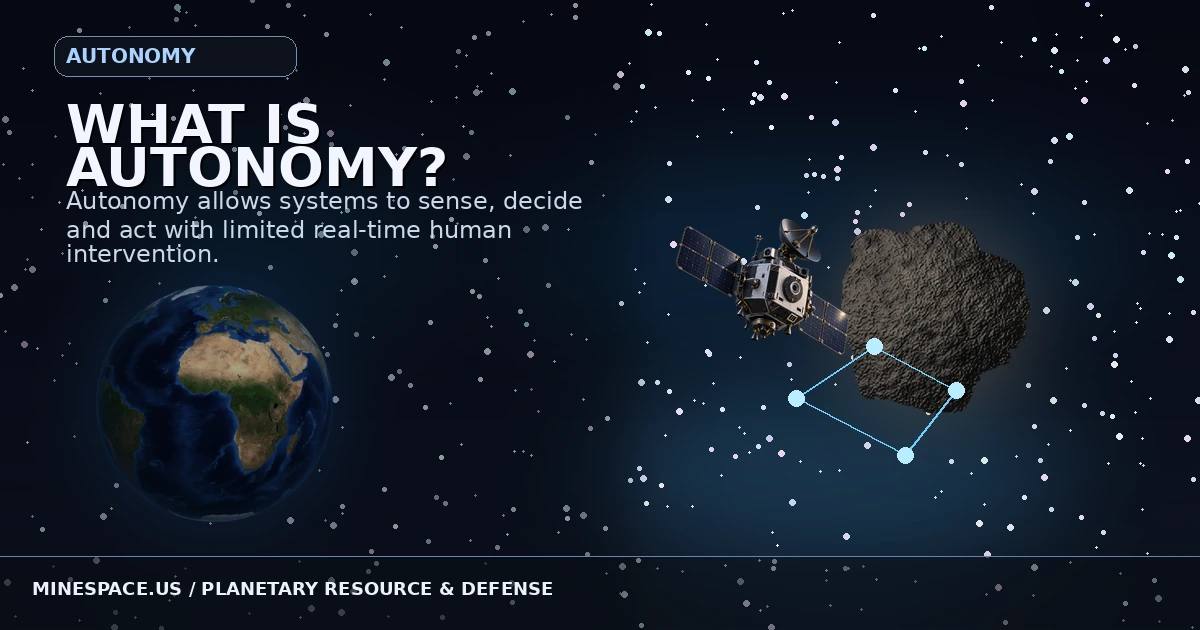
What does autonomous mean?
An autonomous system can observe its environment or internal state, choose among permitted actions and assess the outcome under a defined authority. A ground controller can still set goals, limits, priorities and emergency rules. The aim is not to eliminate humans; it is to let the system handle appropriate decisions at the pace required by its environment.
A simple timer that fires a thruster at a fixed time is automated. A spacecraft that estimates an approaching target’s position, recognizes growing uncertainty, updates a maneuver within flight rules and retreats when safety margins are exceeded is performing a more autonomous task.
Autonomy, automation and artificial intelligence are not synonyms.
- Automation: a predefined procedure executes under known triggers, such as a valve opening at a scheduled time.
- Autonomy: a system chooses or adjusts actions to achieve a goal using measured conditions and constraints.
- Artificial intelligence: a collection of computational methods that may assist perception, planning or decision-making. AI is neither required for every autonomous system nor sufficient to make one safe.
- Human supervision: oversight that establishes goals, permissions and interruption or recovery procedures. Autonomous missions still require mission control and verification.
How does autonomy work in a spacecraft?
Sense
Obtain camera, star-tracker, inertial, radio or other sensor data.
Estimate
Calculate spacecraft attitude, trajectory, relative position and uncertainty.
Plan
Choose a feasible action within fuel, power, collision and mission constraints.
Act
Command pointing, propulsion, communications or an instrument.
Verify
Measure the response, detect disagreement and change plan or enter a safe state.
Is autonomy already used in space?
Yes, in bounded tasks. NASA’s OSIRIS-REx used Natural Feature Tracking to support precise navigation toward Bennu during its sampling operation. Such missions show that onboard sensing and guidance can perform critical functions. They do not imply that every spacecraft can independently make unlimited scientific or operational decisions. See NASA’s Natural Feature Tracking explanation.
What does autonomy mean for Mission Zero?
MineSpace’s intended spacecraft would autonomously approach Apophis, estimate relative motion, match its heliocentric trajectory and maintain a controlled companion position while the asteroid continues around the Sun. Long-duration operation introduces navigation uncertainty, fault detection, propulsion limits, power management, communications outages and retreat decisions. Indefinite accompaniment is an ambition, not a verified lifetime guarantee.
A credible controller does more than hold position. It identifies when uncertainty or a fault exceeds allowed boundaries and chooses a verified safe response.
Related autonomy questions
Does autonomy mean no humans are involved?
No. Human teams define goals, constraints, test procedures and escalation paths. Onboard decisions occur within the authority they permit.
Is autonomy the same as AI?
No. Autonomous behavior can rely on deterministic control, estimation and planning. AI may support some components but is not a requirement.
Why is autonomy important in space?
Communication delays, intermittent links, narrow navigation margins and long mission durations often require onboard responses faster than Earth-based command loops can provide.