 MINESPACE
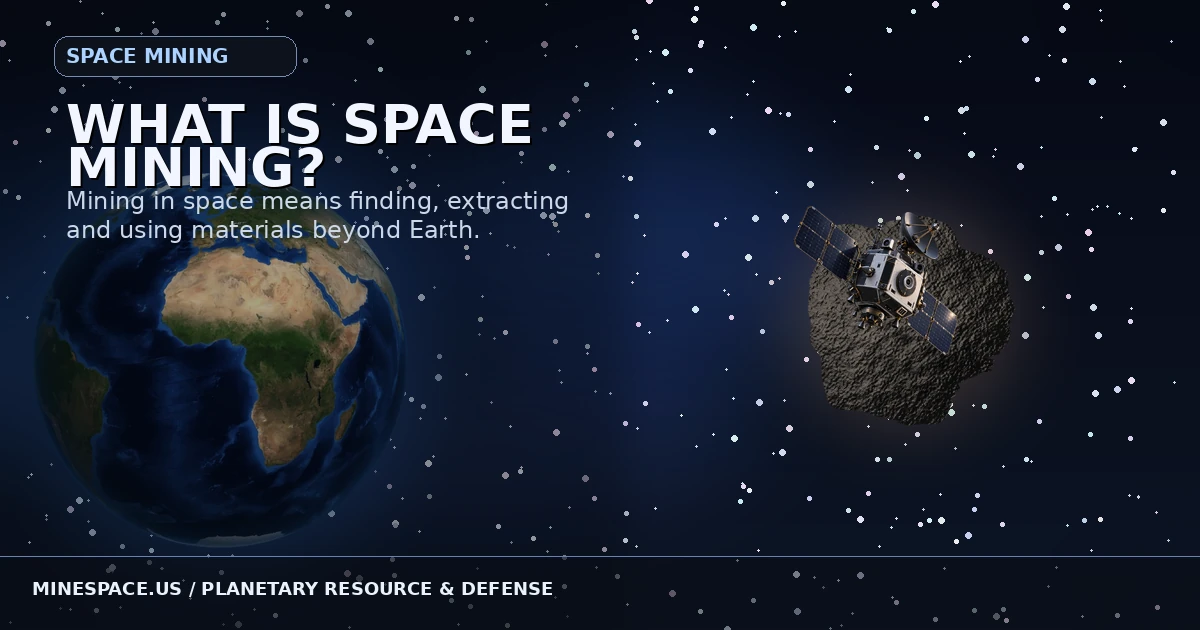
What does “mining in space” actually mean?
The phrase mining in space is often used broadly for finding and recovering natural resources beyond Earth. “Space mining” can refer to extraction from an asteroid, the Moon, another planetary body or—in a wider resources discussion—gases in an atmosphere. A useful distinction is that prospecting identifies a potential resource, extraction obtains it, and in-situ resource utilization (ISRU) converts and uses local material for a mission. A resource estimate alone does not mean that a mine is technically or economically viable.
NASA describes ISRU as using resources already present at a mission destination rather than carrying all supplies from Earth. The complete chain includes locating material, measuring its quantity and form, collecting it, processing it, and storing or using the resulting product. NASA’s ISRU overview is a useful primary reference.
Where could space mining happen?
- Asteroids: investigate water-bearing minerals, metal-rich material and other candidate resources. A particular asteroid’s composition and accessibility must be measured; a label like “asteroid” alone is not enough.
- The Moon: look for water ice in suitable polar environments and for oxygen-bearing minerals in regolith. Excavation, heating, reduction and processing concepts differ by resource.
- Mars: the atmosphere itself can be processed. NASA’s MOXIE experiment demonstrated oxygen production from atmospheric carbon dioxide; this is ISRU, even though it is not digging a conventional mine.
- Other destinations: comets and moons may contain useful materials, but accessibility and operating environments differ greatly.
Why would anyone mine in space?
Launching material from Earth requires a rocket, energy and mission planning. If water, oxygen or structural feedstocks can eventually be produced nearer to where they are needed, a mission may reduce dependence on shipped consumables. Possible uses include drinking water, life support, radiation shielding, propellant ingredients, structural construction and manufacturing inputs. Those are potential applications—not a claim that an economically operating, large-scale extraterrestrial mining industry already exists.
A resource used in space can have a different value proposition from material exported to Earth. The customer, transport distance, processing power and mission reliability change the economics.
Is space mining the same as asteroid mining?
No. Asteroid mining is a subset of space mining. Space mining includes the Moon, Mars and other locations; asteroid mining specifically targets material in an asteroid. Lunar mining often means surface excavation and processing under lunar gravity. An asteroid may instead require anchoring, enclosure, controlled contact or collecting loose surface particles in weak gravity. See what asteroid mining means and how lunar mining differs.
What must happen before a space mine works?
A useful business concept needs more than an interesting asteroid or a promising spectrometer reading. Teams must characterize the deposit, close a mass-and-energy budget, demonstrate excavation or acquisition, measure processing yield, store product without unacceptable loss, and show the whole operation can survive faults with realistic communications delays. A scientifically observed resource is not the same as a demonstrated commercial production system.
Start with the step-by-step mining process, the state of feasibility and the role of autonomy.
Where does MineSpace fit?
MineSpace Inc. identifies as a planetary resource and defense firm. Its public work includes research and mission simulation, while Mission Zero’s stated objective is to autonomously reach asteroid (99942) Apophis, match its heliocentric motion and maintain a controlled companion position for as long as feasible. Mission Zero is not presented as an operating asteroid mine, a spacecraft already launched or a flight-qualified resource-extraction system. A long-duration companion mission could support scientific characterization and future mission learning; prospective resource uses require separate evidence and mission design.
More questions people ask about space mining
What is another name for space mining?
In aerospace research, related terms include space resource utilization, extraterrestrial resource extraction and in-situ resource utilization (ISRU). ISRU focuses especially on using local resources at a mission destination.
Can space mining provide water?
Potentially. Researchers investigate water ice and hydrated minerals at suitable destinations. Recoverability, concentration, power demand and storage remain specific engineering questions.
Does space mining mean mining only asteroids?
No. Asteroid mining is one category. Lunar regolith processing, extraction of lunar water ice and processing gases in the Martian atmosphere also fit the wider space-resources field.