 MINESPACE
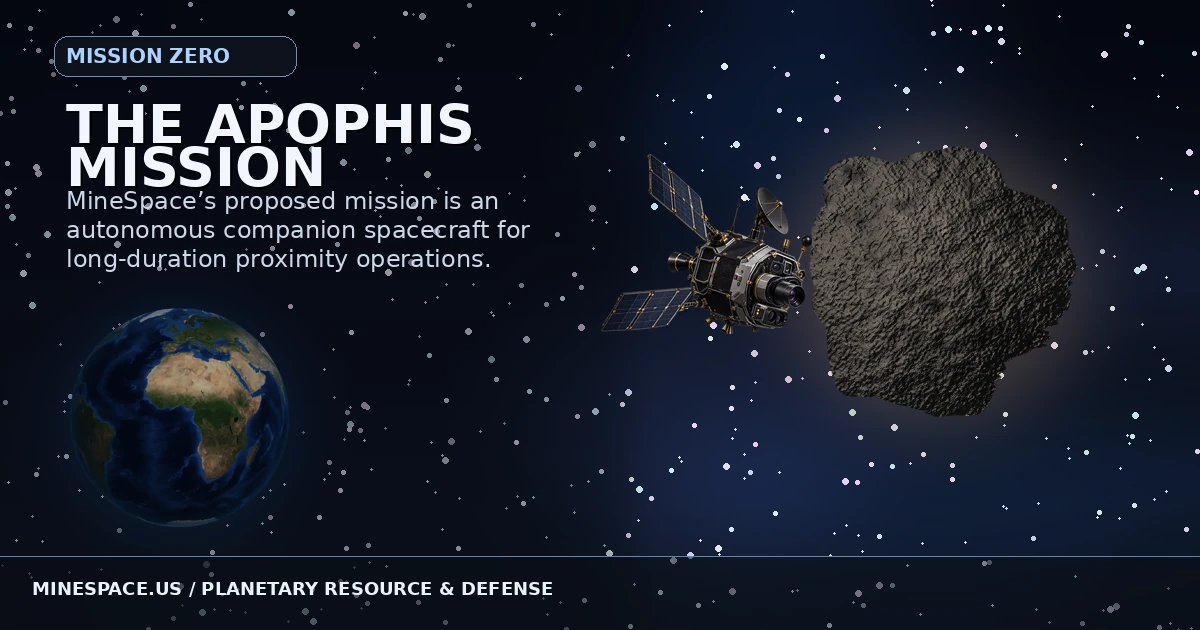
A mission to remain—not just pass.
MineSpace Inc.’s Mission Zero objective is to develop an autonomous spacecraft mission that reaches (99942) Apophis, matches its motion around the Sun and remains in a controlled companion position for as long as feasible. The object is to accompany a small body along its heliocentric path. It is not necessary to describe the spacecraft as orbiting Apophis itself in a close, traditional satellite orbit.
The 2029 close approach creates both a compelling opportunity and an engineering constraint. Earth’s gravity will change Apophis’s heliocentric orbit. A spacecraft designed to stay near it must account for the encounter and the post-flyby trajectory as part of a complete mission-design study.
Companion flight is the objective. Perpetual operation is an aspiration that depends on power, propulsion, navigation, communications, safe proximity and the spacecraft's actual lifetime.
Autonomous approach and target acquisition.
Before a long-duration formation exists, the vehicle must reach an appropriate heliocentric transfer path, acquire Apophis against its background and refine relative position and velocity estimates. A camera alone is not a navigation system: measurement timing, uncertainty, attitude knowledge, exposure conditions and fault detection are part of the design.
Matching heliocentric motion.
For a spacecraft to travel alongside an asteroid over long durations, it must reduce relative velocity and control separation while both continue orbiting the Sun. The relevant mission questions include propellant and maneuver budget, target ephemeris uncertainty, solar radiation pressure, spacecraft attitude and navigation cadence. The Earth encounter adds a trajectory transition that requires explicit modeling.
Formation flight is an active control problem.
A companion position beside Apophis is not automatically stable forever. Depending on range and relative geometry, a guidance system may need small corrections to respond to differential forces, trajectory-estimation error and other perturbations. A high-quality mission architecture therefore defines separation envelopes, minimum safe distance, line-of-sight constraints, maneuver authority and contingency behavior—not just a dramatic visualization of a parked spacecraft.
Fly beside the object.
Explore the conceptual autonomous pursuit, acquisition, matching, holding and continuation sequence.
Designing for long-duration autonomy.
The indefinite companion idea directs engineering attention to low-maintenance operation. Mission studies must consider solar-array output across the heliocentric orbit, thermal conditions, communications availability, time-delayed ground contact, propulsion reserve, attitude control, safe-state recovery and instrument degradation. “Autonomous” does not imply no human oversight; it specifies onboard capability to maintain a safe, productive state when immediate operator action is not available.
A realistic progression separates mission goal, feasibility analysis, subsystem requirements, simulation evidence, integrated tests and ultimately flight qualification. The website’s illustrated controller and cinematic spacecraft are not proof of those future milestones. Explore the mission design study and the mission architecture.
How Mission Zero relates to NASA's Apophis research.
NASA's OSIRIS-APEX is a real, separately managed asteroid rendezvous mission that NASA describes as arriving at Apophis after its 2029 Earth encounter. MineSpace's site does not claim to operate, own or partner in OSIRIS-APEX. Mission Zero is MineSpace Inc.'s own stated objective and simulation-led engineering program.
MineSpace invites technical collaborators, strategic partners and investors interested in the mission to contact the company. Any real flight design would need independently validated trajectory, mission assurance, spacecraft engineering and program milestones.