 MINESPACE
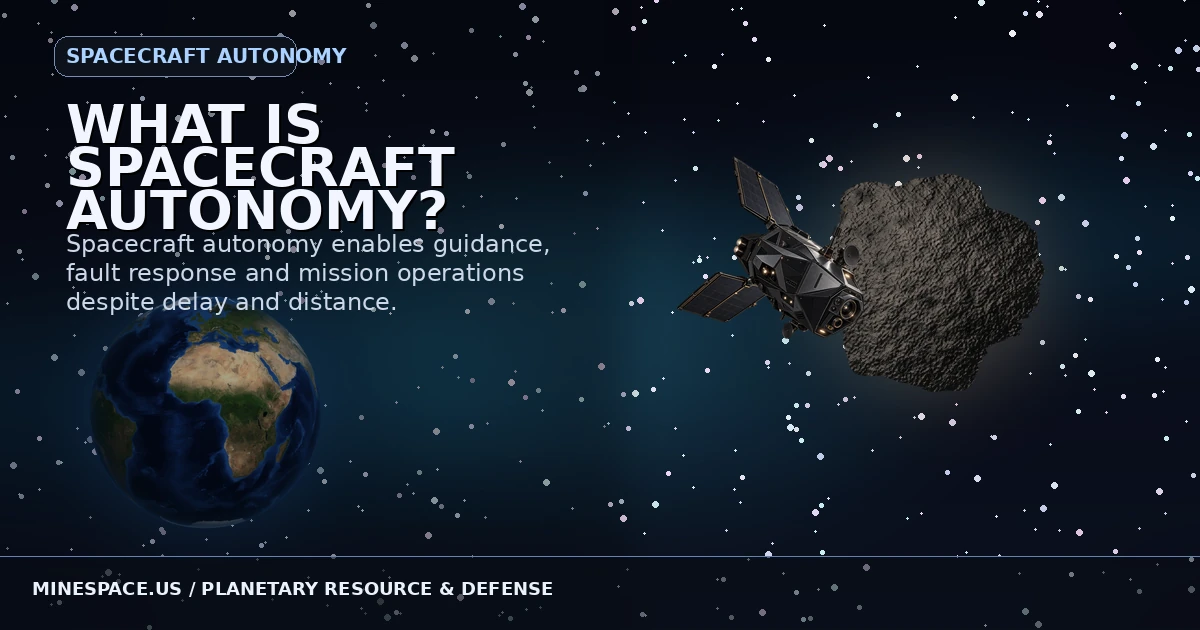
How does autonomous spacecraft navigation work?
A navigation system combines observations, a dynamics model and uncertainty estimates to infer where the spacecraft and target are and how they move. Onboard observations may include images, stars, inertial sensors and radio measurements. The controller compares its estimated state against mission objectives and constraints, then chooses whether to observe, maneuver, hold or retreat.
The most important detail is that a navigation answer has uncertainty. A spacecraft can appear to be beside its target while still having an unsafe relative-velocity error or uncertain surface geometry. Safety decisions must use uncertainty and collision margins, not merely an attractive visual distance.
What happens during autonomous asteroid rendezvous?
Cruise and target acquisition
Use external and onboard information to approach the predicted target neighborhood.
Relative navigation
Resolve the asteroid in the sensor field and estimate position, velocity, rotation and uncertainties.
Velocity matching
Reduce relative velocity with controlled maneuvers while keeping a safety corridor.
Companion formation
Maintain a chosen relative geometry; monitor navigation, attitude, power and propulsion resources.
Safe retreat and recovery
If estimates or hardware degrade, transition to a verified safe mode or departure trajectory before reattempting operations.
Why not steer everything from Earth?
Light-time delay grows with distance, and a communications link may be intermittent. Even if control personnel are available continuously, they cannot always respond in time to fast proximity-navigation events. A bounded autonomous controller can execute preauthorized responses while logging decisions for subsequent ground review.
Safe states, maneuver limits, keep-out regions, fault thresholds and command permissions are part of the design.
Has real asteroid navigation used onboard autonomy?
NASA’s OSIRIS-REx used Natural Feature Tracking to compare camera observations with mapped surface features during Bennu sampling. It is an example of targeted autonomous navigation enabling a high-precision maneuver; it is not evidence that a hypothetical Mission Zero spacecraft has been built or qualified.
What would Mission Zero need to prove?
MineSpace Inc. intends to travel autonomously to Apophis, match its heliocentric motion and sustain a controlled companion position as long as feasible. Design verification would need to cover target acquisition, navigation observability, collision risk, propellant use, sun-angle constraints, communications loss, fault recovery and long-duration environmental effects. The public companion simulation is a conceptual visualization, not a validated trajectory or existing flight system.
Experience the companion mission visualization, examine the encounter study, or return to autonomy fundamentals.
Common spacecraft-autonomy questions
Is autonomous rendezvous the same as docking?
No. Rendezvous means reaching suitable relative motion and geometry. Docking adds physical connection and its own sensing and contact-control requirements.
Can an autonomous spacecraft stay beside an asteroid forever?
Indefinite companionship is an aspiration, not a promise. Real mission lifetime depends on fuel, navigation, system reliability, power and the dynamical environment.
Does stationkeeping mean remaining at a fixed absolute point?
No. A companion follows the asteroid’s motion around the Sun while controlling its position relative to that moving target.