 MINESPACE
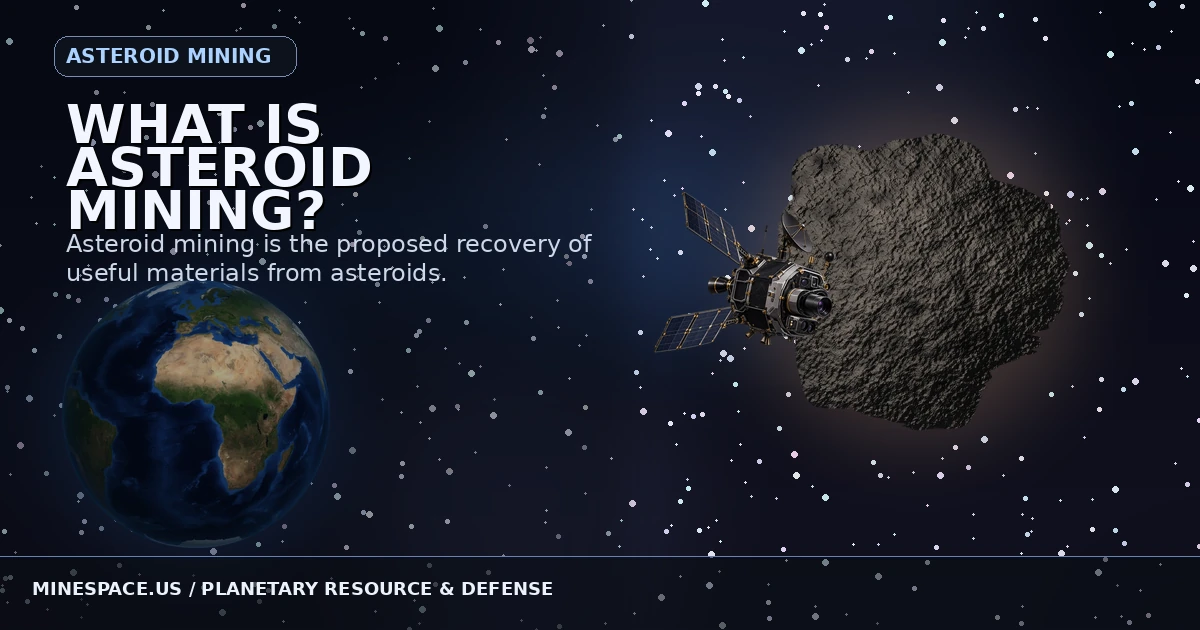
What does mining an asteroid involve?
Asteroid mining means attempting to extract material from a small body orbiting the Sun and then using or transporting that material. The asteroid is not a giant ready-made ingot; it may be fractured, rubble-pile-like, boulder-rich or compositionally mixed. A mission has to determine the target’s actual characteristics before choosing a collection method.
Asteroid exploration has demonstrated that spacecraft can rendezvous with and sample a small body. NASA’s OSIRIS-REx mission collected and returned material from Bennu. Scientific sample return, however, is not proof of profitable industrial mining. The scale, power, production yield and reliability requirements are different.
What minerals or materials could an asteroid hold?
- Water and hydrated minerals: some carbon-rich bodies contain minerals altered by water; extracting usable water is a distinct processing challenge.
- Iron and nickel: some asteroid populations contain metal-bearing material, but target-specific measurements are essential.
- Other metals: theoretical resource discussions sometimes mention precious-group metals. Their recoverable quantity, economics and market demand cannot be assumed from an asteroid’s spectral class.
- Regolith: loose particulate material may be useful for scientific study or possible construction feedstock after characterization.
NASA reported water-related minerals and carbon-rich material in Bennu samples returned by OSIRIS-REx. That supports the scientific importance of asteroid composition studies; it does not establish a mining reserve at another asteroid. Read NASA’s Bennu sample report.
Why is asteroid mining harder than digging on Earth?
A shovel or drill pushes back on its operator. On a small asteroid, reaction forces can move a spacecraft unless it has a suitable hold-down method or collection architecture. Dust, uneven terrain, uncertain cohesion, rotation and delayed communications complicate operations. Some concepts therefore study contactless collection, sampling mechanisms, temporary attachment or enclosing a material stream, depending on the asteroid and product.
A mining or science spacecraft must first navigate into the target’s vicinity, estimate relative motion and establish safe operations. Approach, stationkeeping and retreat are mission-critical capabilities.
How might an asteroid mining mission work?
Select a target
Compare orbit, required propulsion, observable composition, size, rotation and mission access—not just a guessed dollar value.
Characterize the asteroid
Use remote sensing and, if practical, proximity observations or samples to constrain material and surface behavior.
Acquire material
Collect representative material with a mechanism matched to local gravity, terrain and body rotation.
Process and store
Extract the intended product, separate contaminants and retain it with measured yield and loss.
Deliver usable output
Supply a spacecraft or depot, or evaluate a return-to-Earth path under realistic transport and market assumptions.
Is Apophis being mined by MineSpace?
No. MineSpace Inc.’s Mission Zero is the objective of autonomously traveling to (99942) Apophis, matching its motion around the Sun and maintaining a controlled companion position for the longest feasible time. Its visualizations are simulations; no launched MineSpace mining spacecraft or established Apophis mining reserve is claimed. Apophis is commonly described by NASA as a stony, S-type asteroid, and its 2029 Earth flyby is scientifically significant. Do not infer that the 2029 encounter establishes an economically recoverable deposit.
Explore the Apophis facts, the companion mission visualization, and why autonomous navigation matters.
Asteroid mining questions
Is asteroid mining science fiction?
Sampling and asteroid rendezvous have been demonstrated by public missions. A sustained, economically viable industrial asteroid mine is a different and far more demanding capability.
Would asteroids be mined for gold?
Some resource proposals include valuable metals, but a viable mine needs verified concentration, recovery process, energy budget, transport solution and a customer. Gold alone is not a business case.
Would asteroid mining damage Earth?
Impacts on Earth are not an inherent part of asteroid mining. Operations must instead address spacecraft and material control, debris, trajectory safety and applicable governance. Individual mission designs require separate risk assessment.