 MINESPACE
THE FRONTIER / SOURCE GUIDE
SPACE
EXPLORATION HISTORY.
A source-led guide to the missions and historical photographs featured in The Frontier.
ORIGINAL MINESPACE VISUALIZATION · NOT SPACECRAFT FLIGHT FOOTAGE
01 / HISTORICAL RECORD
THE IMAGES BEHIND THE FRONTIER.
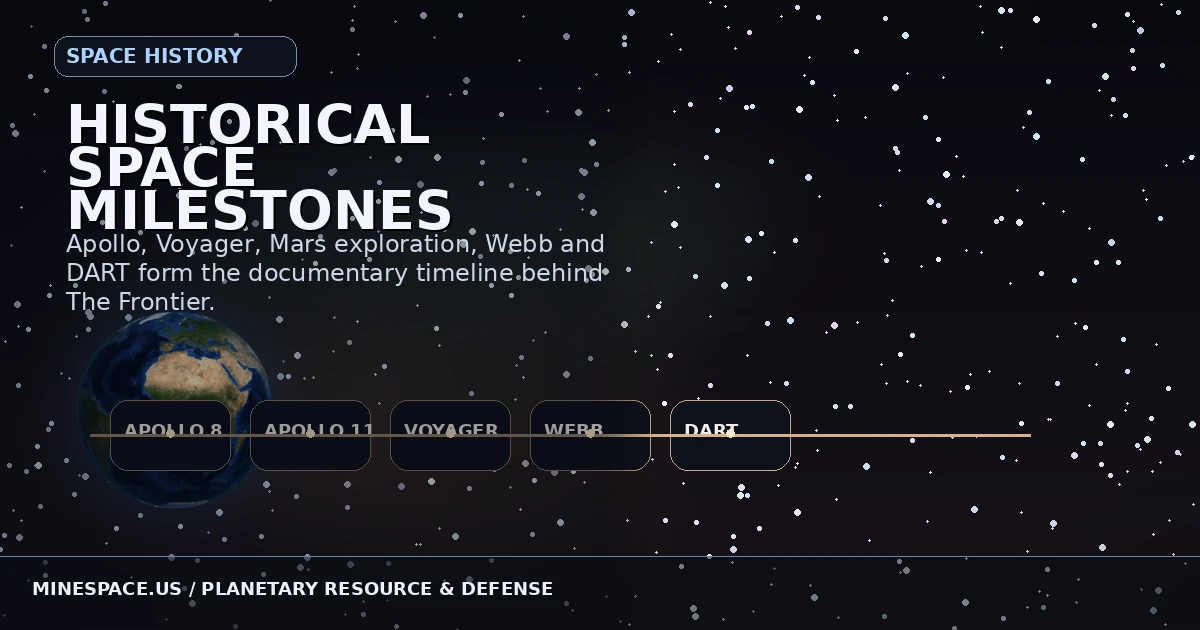
This guide documents the historical mission moments featured in MineSpace’s interactive space film. The sequence is arranged editorially: the photographs themselves are historical records; MineSpace’s Earth–Apophis interludes are simulated artwork, not photographs from the listed missions.
Some of the online images are modern reprocessings or composites of original data. In particular, Webb images are multi-wavelength science compositions, and the popular “Pale Blue Dot Revisited” is a modern reprocessing of Voyager’s 1990 view. Where an image was reprocessed, that does not alter the date of the original observation.
1968 / THE MOON ORBIT
APOLLO 8 — EARTHRISE.
On December 24, 1968, the Apollo 8 crew saw Earth rising above the lunar horizon. William Anders’s color Earthrise photograph remains one of the defining images of human spaceflight. This is an image of Earth from lunar orbit, not a MineSpace render.
1969 / THE MOON LANDING
APOLLO 11 — LAUNCH, LANDER, FOOTPRINT.
Apollo 11 launched on July 16, 1969, and landed on the Moon on July 20. Distinct archival frames in our film depict the Saturn V launch, Lunar Module on the surface and evidence of human activity in lunar soil. Their captions should identify the individual scene rather than treating them as one generic Moon photograph.
1990 / OUTWARD PERSPECTIVE
VOYAGER 1 — PALE BLUE DOT.
Voyager 1 captured Earth on February 14, 1990, during a final portrait of the solar system. The small illuminated point was photographed from around six billion kilometers from the Sun. The popular revisited image was processed decades later from the original observation.
2021 / ROBOTIC EXPLORATION
PERSEVERANCE AND INGENUITY.
Perseverance photographed itself with the Ingenuity helicopter on Mars in April 2021. The film uses this historical exploration milestone to connect lunar-era ambition with modern autonomous and remotely operated exploration.
2022 / OBSERVING DEEP SPACE
WEBB — FIRST DEEP FIELD.
The James Webb Space Telescope’s first deep field of SMACS 0723 was released in July 2022. It is a scientific infrared composite, not a literal human-eye photograph, and reveals galaxies and structures made visible through the telescope’s instruments and processing.
2022 / PLANETARY DEFENSE
DART — THE DIMORPHOS DEMONSTRATION.
On September 26, 2022, DART struck Dimorphos. Follow-up observations confirmed its orbital period around Didymos had changed. DART targeted Dimorphos—not Apophis. MineSpace’s Apophis companion concept pursues sustained observation and proximity operations, not a DART-style impact.
THE MISSION ZERO TRANSITION
THE RECORD ENDS. OUR ENGINEERING QUESTION BEGINS.
Apophis makes a safe close Earth approach on April 13, 2029. The film’s final chapter introduces MineSpace’s independent objective to rendezvous and accompany Apophis over the long term. The historic NASA photographs in the film are attributed to their creators and do not imply institutional participation in MineSpace’s future mission.
Return to the film overview, examine Apophis asteroid facts, or continue to the MineSpace encounter experience.
EXPLORE THE FILM.
ENTER THE MISSION.
Follow the historical record, then step into MineSpace’s proposed autonomous Apophis companion mission and interactive engineering studies.