 MINESPACE
THE SCIENCE / PLANETARY DEFENSE
PLANETARY
DEFENSE.
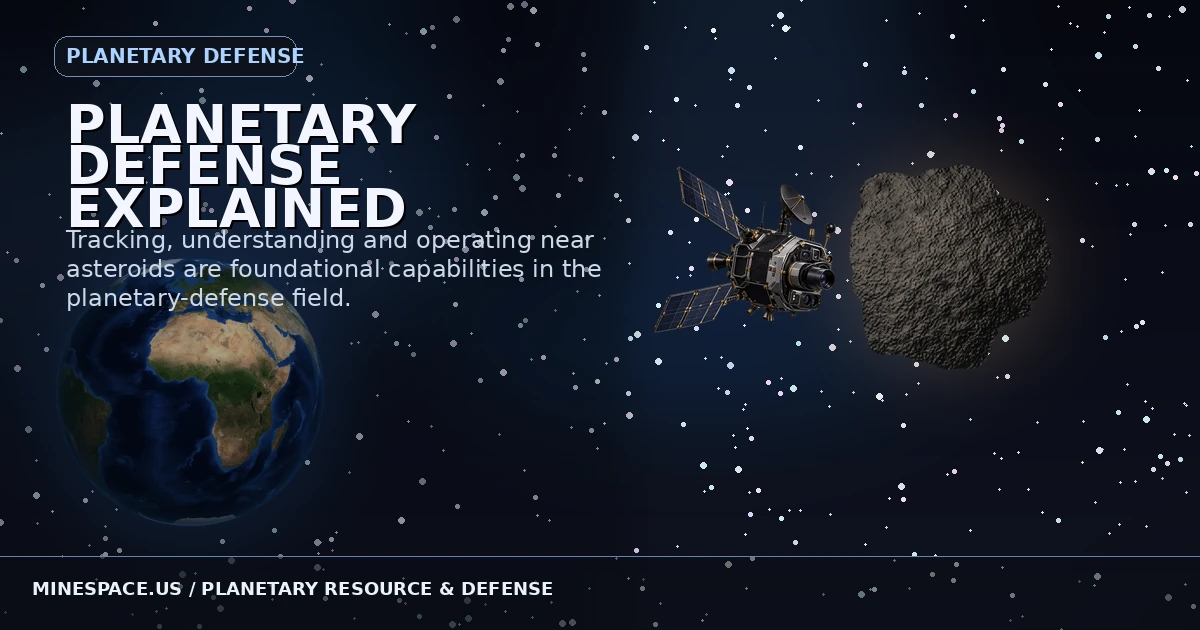
Asteroid discovery, precise observation and autonomous spacecraft operations are connected disciplines—not a claim that a safe Apophis flyby is an emergency.
ORIGINAL MINESPACE VISUALIZATION · NOT SPACECRAFT FLIGHT FOOTAGE
01 / THE FIELD
UNDERSTAND THE OBJECT BEFORE MAKING A DECISION.
Planetary defense is the work of discovering, tracking and characterizing near-Earth objects, assessing potential impact risk, and studying ways to mitigate a threat if one is identified. It involves astronomical observation, orbit determination, uncertainty analysis, mission planning and coordinated response—not just asteroid deflection.
MineSpace’s proposed Apophis companion mission relates primarily to observation, autonomous guidance and long-duration operations. Apophis’s 2029 flyby is scientifically important precisely because it is unusually close and safe; it is not a predicted impact event.
Detection & discovery.
Surveys locate asteroids and gather observations over time. A new detection is the start of analysis, not an automatic hazard designation.
Orbit & uncertainty.
Repeated measurements constrain the asteroid trajectory. Encounter forecasts depend on current observations and an appropriate dynamical model.
Size, shape & motion.
Rotation, composition, shape and surface properties affect mission design and scientific interpretation.
Autonomous spacecraft.
Navigation, communications, power, propulsion and safe-relative-motion management are essential to accompany a small body rather than simply pass it.
02 / WHAT DART SHOWED
AN ACTUAL DEFLECTION TEST, NOT AN APOPHIS IMPACT.
NASA’s DART spacecraft struck Dimorphos on September 26, 2022. Observations subsequently confirmed a change in Dimorphos’s orbital period around the larger asteroid Didymos. The demonstration showed that a kinetic impactor can alter an asteroid’s motion in a measurable way under the circumstances tested.
MineSpace’s current Apophis objective is different: rendezvous and sustained autonomous companionship for observation and science. The DART chapter in The Frontier belongs to space exploration history; it is not footage of Apophis being struck or of a MineSpace operation.
03 / RESOURCE & DEFENSE
WHY THESE TWO DIRECTIONS BELONG TOGETHER.
Studying an asteroid’s motion and studying its physical properties demand overlapping capabilities: reliable relative navigation, observation instruments, autonomy, long-life systems and reproducible mission analysis. Those same capabilities may support future off-Earth resource studies, even though identifying a resource is not the same as demonstrating a practical extraction system.
MineSpace’s public engineering pages describe proposed capabilities and simulations. They are not flight-test certifications or completed hardware claims. Read the broader Planetary Resource & Defense profile, learn about Apophis 2029, and explore companion-flight visualization.
04 / THE HISTORICAL FILM
HOW A DOCUMENTARY CONNECTS TO AN ENGINEERING FIELD.
The Frontier brings the historical record into an editorial arc: Apollo 8 and Apollo 11, Voyager, robotic Mars exploration, Webb and DART. Each photograph is historical mission material; MineSpace’s rendered Earth and asteroid act as a visual bridge into the proposed Mission Zero effort.
The scientific sources are credited in the film history guide. The film is not produced by NASA, and no NASA affiliation is implied by its use of publicly accessible historical imagery.
EXPLORE THE FILM.
ENTER THE MISSION.
Follow the historical record, then step into MineSpace’s proposed autonomous Apophis companion mission and interactive engineering studies.